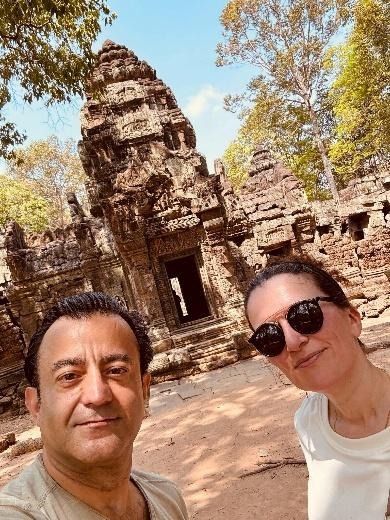
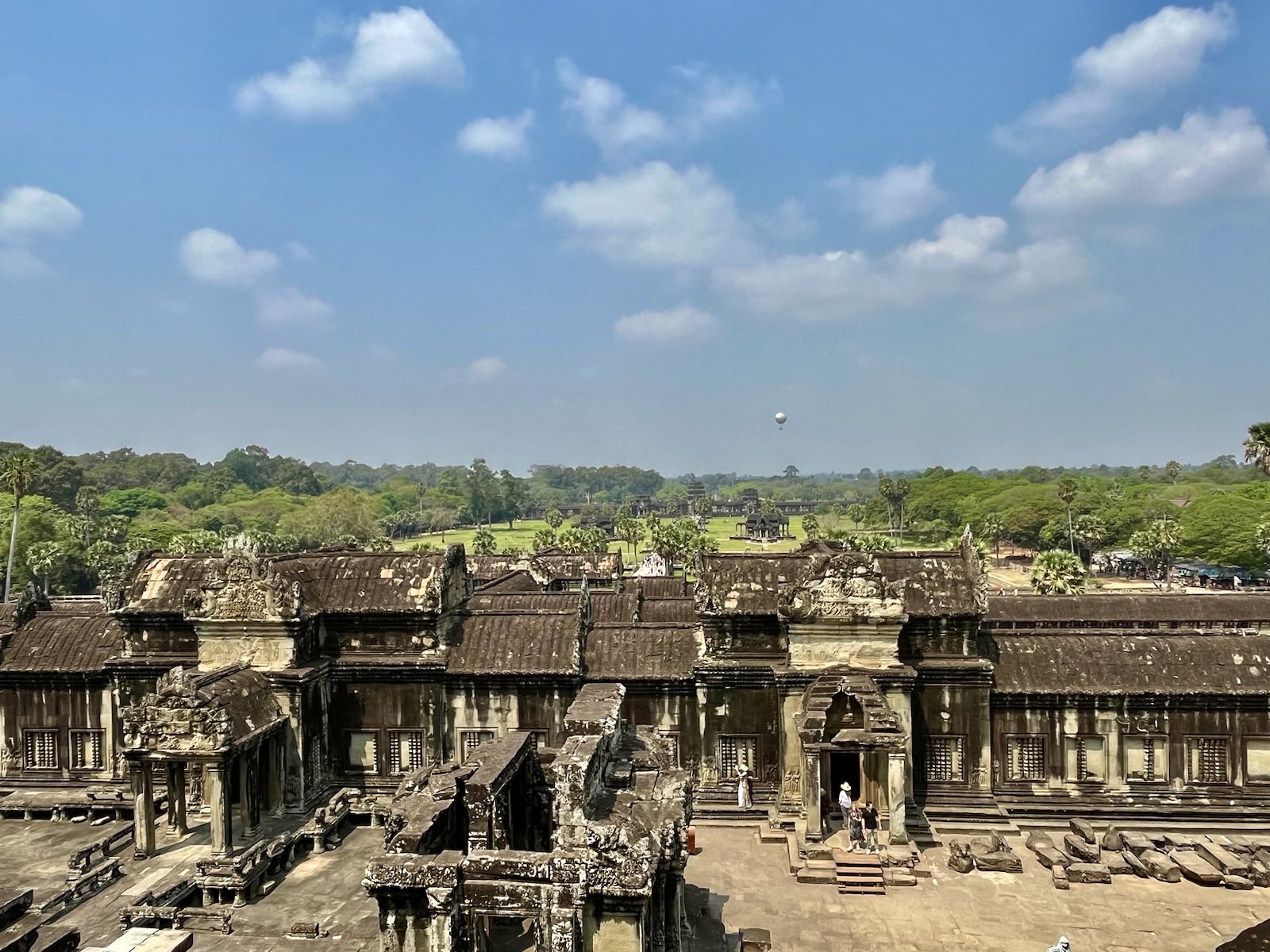
Nexus recently had the privilege of facilitating a team retreat in Cambodia. Between workshops, reflections and shared meals, one moment stood out for all of us: our visit to Angkor Wat, the awe-inspiring temple complex of the ancient Khmer Empire.
Standing in front of those towers at sunrise, it is hard not to wonder: how did people build this, nearly nine centuries ago, without cranes, computers or project management software?
The numbers are humbling. The Angkor Archaeological Park stretches over some 400 km² and holds the remains of the successive capitals of the Khmer Empire, from the 9th to the 15th century, including Angkor Wat and the Bayon temple with its countless sculptures. UNESCO lists it as a World Heritage Site and describes the layout of these capitals as evidence of a highly organised society. (UNESCO World Heritage Centre)
Angkor is not only a wonder of stone. It is a story of people working together at a scale few civilisations ever reached, and of what happens when the systems that hold them together are neglected. This remarkable place left our group with five powerful lessons for teamwork and collaboration today. Here they are, with practical tips you can use with your own team.
Lesson 1: Every role matters in great achievements
History books often remember the kings who ordered the temples. But Angkor was built by thousands of people whose names we will never know: stonecutters who shaped the sandstone blocks, engineers who designed the foundations and water systems, artists who carved the endless bas-reliefs, workers who transported the stone. Without each of them, there would be no Angkor.
The same is true in your team. Collaboration is at its best when every team member, from junior roles to leadership, feels seen, respected and included.
This is not only a matter of kindness. It is a matter of performance. Research by Deloitte found that teams with inclusive leaders are 17% more likely to report that they are high performing, 20% more likely to say they make high-quality decisions and 29% more likely to report collaborative behaviour. (Deloitte research, cited by FranklinCovey/Business Wire)
How to make every role visible in your team:
- Map the contributions. In a team meeting, draw the journey of a recent success and ask: who contributed what? You will often discover invisible work that made everything possible.
- Thank people by name and by action. Specific recognition (“Your preparation of the client file made the meeting a success”) means more than a general “well done, everyone”.
- Invite junior voices first. In discussions, give the floor to newer or junior colleagues before senior ones, so their ideas are not shaped by what the boss already said.
- Explain the why. Show each person how their task connects to the bigger goal. A stonecutter who knows they are building a temple works differently from one who is just cutting stones.
Lesson 2: Adaptation sustains collaboration
Angkor thrived for centuries in a demanding environment, with heavy monsoon rains followed by long dry seasons. To survive, the Khmer built what researchers call a “hydraulic city”: miles of canals and dikes, irrigation channels for crops, overflow channels for the monsoon, and huge reservoirs, the largest covering about 16 km². Researchers have also found signs that the people of Angkor kept modifying this network to cope with a changing environment. Flexibility was key to their survival.
Today, teams work in what is often called a VUCA world: volatile, uncertain, complex and ambiguous. Plans made in January may be outdated by June. The teams that last are not the ones with the perfect plan, but the ones that know how to adjust plans, roles and tools when the environment or goals shift.
A modern example: Netflix started in 1997 by mailing DVDs in red envelopes. In 2007, it launched streaming, while its DVD business was still running. Over the following years, it steadily moved its members toward streaming. By 2022, DVDs generated only about 0.5% of revenue, and Netflix sent its last disc on 29 September 2023. The company did not wait for its core business to collapse. It adapted while it was still strong.
How to build an adaptable team:
- Plan in short cycles. Keep a long-term direction, but review priorities every quarter, or even every month.
- Hold regular “what has changed?” moments. Ask the team: what is different in our environment, our clients, our tools? What should we stop, start or continue?
- Develop flexible roles. Cross-train colleagues so that the team can absorb absences, peaks and new projects without stress.
- Celebrate learning, not only success. A team that is afraid of failure will cling to old plans. A team that learns from mistakes will adapt faster.
Lesson 3: Coordination requires structure
Imagine coordinating the construction of Angkor Wat: quarrying stone far away, moving it to the site, aligning every block, carving every wall, while feeding and organising the workforce and managing water through the seasons. None of this was possible without clear organisation, planning and roles. UNESCO notes that the layout of Angkor’s successive capitals bears witness to a high level of social order. The Angkorian society excelled at synchronising complex systems.
Modern teams need the same clarity. Not bureaucracy, but clear structures, roles, processes, the right tools and realistic timelines. Without them, even the most motivated people waste energy on duplicated work, missed handovers and endless email threads.
The data shows how often this basic clarity is missing. Based on Gallup’s work with companies worldwide, only about half of employees strongly agree that they know what is expected of them at work. (Gallup)
Simple structures that make collaboration smooth:
- A team charter. One page that states the team’s purpose, goals, roles and ways of working. Write it together and revisit it every six months.
- Clear decision rights. For important topics, agree on who decides, who is consulted and who is informed. A simple RACI table (Responsible, Accountable, Consulted, Informed) prevents many conflicts.
- A rhythm of meetings. A short weekly check-in for coordination, a monthly review for priorities, a quarterly session for strategy. Each with a clear purpose.
- The right tools, used the same way. Agree on which channel is used for what: chat for quick questions, email for formal decisions, a shared board for project tracking.
- Visible timelines. Put milestones where everyone can see them, so the team knows what is coming and who depends on whom.
Ready to build an amazing Team and long-lasting results?
Contact us to plan a team day or retreat to